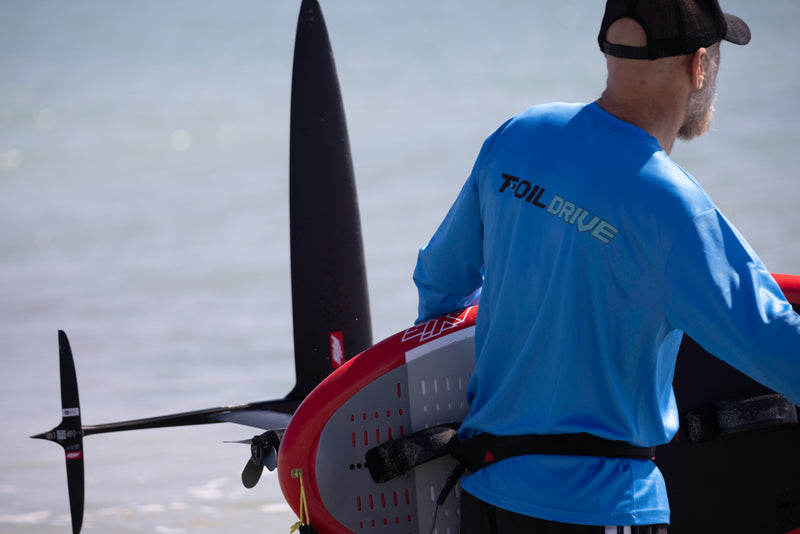
Foil Drive Max+ Base Kit
$4,001.00

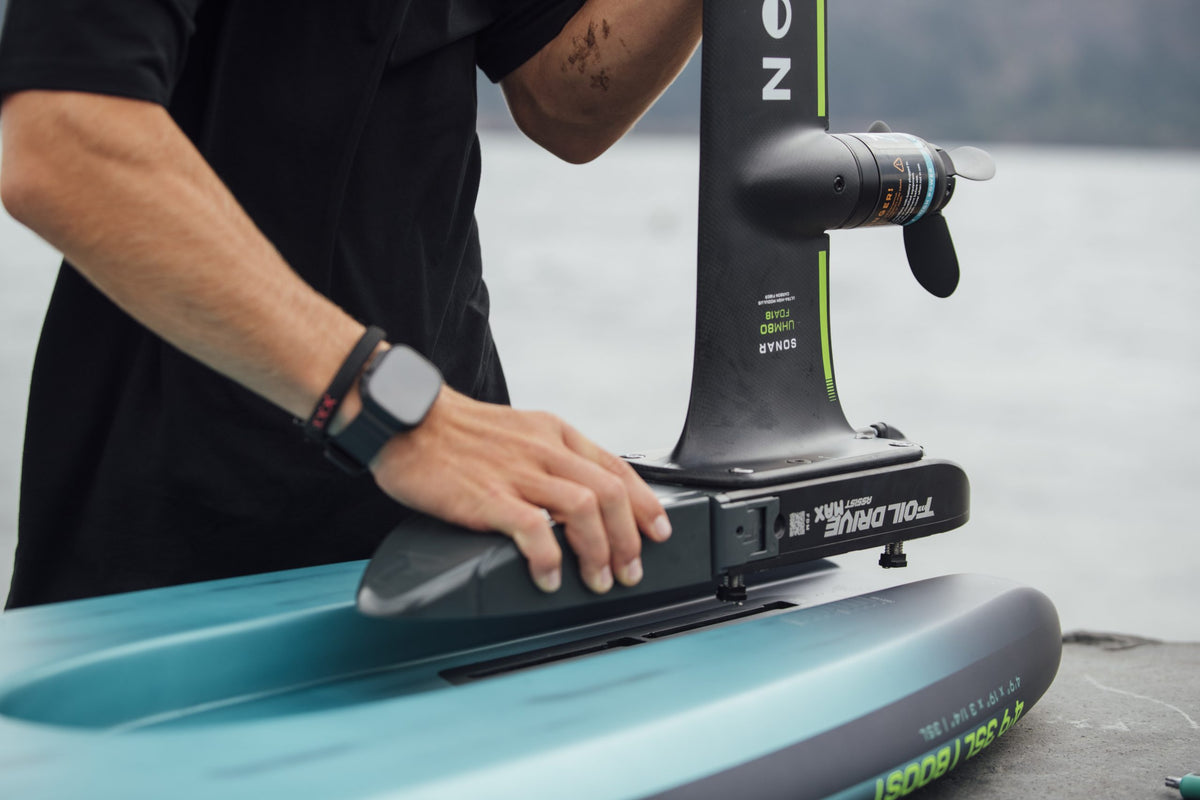
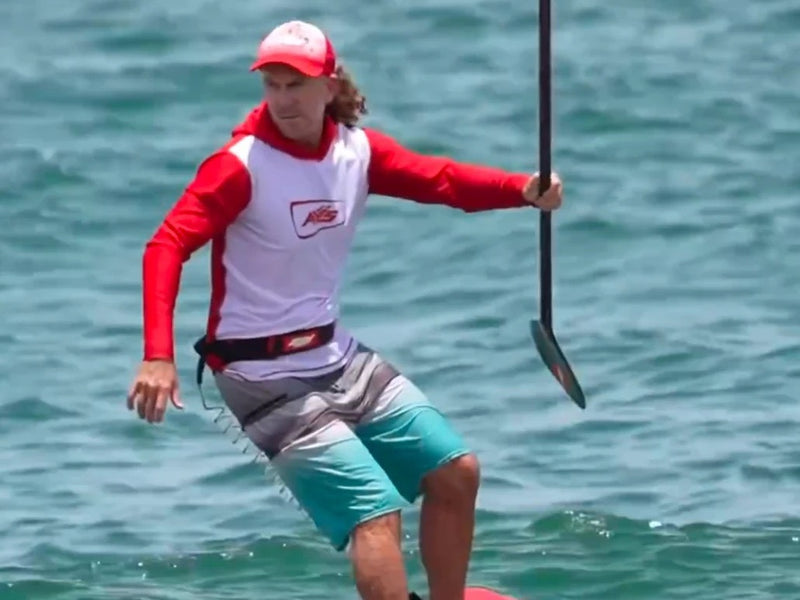
A Foil Drive is a removable electric motor and battery that bolts onto a foil board and mast. It gets you up on foil, and then you let off the trigger and ride the wave or pump on your own.
If you weigh under about 200 lb and want a light, all-round setup, start with the Max+. If you're over 200 lb, brand new to foiling, or need a long run out to your break, the Fusion is the safer pick.
That's the answer Chris and Brian Trappy give at the counter in Fort Pierce, usually after an hour or two of questions. Fin & Foil was the 5th Foil Drive dealer in the US and held the first Foil Drive demos in the country. Today it is the Foil Drive warranty and repair center for the US, so most of what breaks, and why, crosses their bench.
The mast, props, cable, board and add-ons all depend on two answers: whether you want an assist or an eFoil, and which box you're buying.
Buy the Max+ if you weigh under about 200 lb and want the lightest, most natural-feeling setup. Buy the Fusion if you're over 200 lb, a first-timer who needs every bit of help getting up, or you have a long run out to your break. Chris Trappy asks four questions in the shop to get there, in this order: budget, power, runtime, thrust.
Max+ vs Fusion
| Specifics | Max+ | Fusion |
|---|---|---|
| What's different | The electronics box. Motor, props and cables are shared | The electronics box. Motor, props and cables are shared |
| Max thrust | 35.5 kg (78 lb) | 37.5 kg (83 lb) |
| Batteries it takes | 650, plus the 430 sport battery when it's released | 860, 650 (with adapter), plus the 430 when it's released |
| Install weight, biggest battery | 14.8 lb with the 650 | 17.8 lb with the 860 |
| Runtime, light / heavy use | 65 / 45 min with the 650 | 90 / 60 min with the 860 |
| Price | Base price | About $1,200 more |
| Best for | Riders under about 200 lb, a light foil feel, travel | Riders over 200 lb, first-timers, long runs out to the break |
Thrust, weight and runtime are Foil Drive's published figures. The runtimes are for an 85 kg (about 187 lb) intermediate rider. Brian's take on runtime: “Your mileage may vary is like the buzz word.” The more time you spend under throttle, the shorter your session.
The two base kits
 Foil Drive Max+ Base KitShop now →
 Foil Drive Fusion Base KitShop now →
 Foil Drive Fusion 860 BatteryShop now →
Chris explains that both base kits share the same components except the electronics box. So the motor, props, cable and pod you choose later work on either one.
The Fusion box is bigger. It makes more power, takes the largest battery, and runs the longest.
Chris names its two downsides plainly: it's heavier, and it costs about $1,200 more. The Max+ is the lighter, more all-round box. It's a little less powerful and won't run quite as long, but under your feet it feels closer to riding with no motor at all.
Chris steers four kinds of riders toward the Fusion:
Budget comes first, though. If the extra $1,200 would stretch you, Chris won't push the Fusion, and the Max+ handles most riders under 200 lb without trouble.
Yes, for lighter and more athletic beginners. Foil Drive built the Max+ as its all-rounder, and it makes more power than the Assist Max it replaced. A fit first-timer under about 200 lb won't feel short on thrust. That rider also won't outgrow it, because the lighter box suits pumping and wave riding later on.
The beginners who struggle on a Max+ are the ones Chris sends to the Fusion: heavier riders, and riders who will need the motor for most of their session at first.
The smaller batteries change the Fusion more than the Max+. Chris says the Fusion “just wasn't really a big hit with a lot of people because of the weight.” Running a 650 in a Fusion keeps its full thrust and brings the install down to about 15.7 lb. That leaves one box with two personalities: the 860 for long sessions, and the 650 when you want it lighter.
It can be, if the price reflects its age. The Assist Max was discontinued in September 2026 and replaced by the Max+. Owners are still supported with parts and batteries, and Brian notes “there's a pretty strong secondhand market” for older units. The catch is that the Assist Max runs on 40V, while the Max+ and Fusion run on 43V. Batteries and chargers don't cross over in either direction, so a used Max means staying with Max batteries.
If you're shopping secondhand, have the shop check the unit first. They're the people who fix them for the whole country.
For the full breakdown by budget, power and run time, with four starting builds by weight and skill, read Foil Drive Max+ vs. Fusion: how to choose.
Retrofit if you already own a foil you like, or you want to be able to move the motor. Buy an integrated mast if you want the most efficient setup and the easiest battery swaps, and you're ready to pay for a new mast.
Chris calls an integrated mast the single biggest upgrade you can make to a Foil Drive, and also the most expensive one.
Mast types
| Specifics | Retrofit (motor with cable) | Integrated mast |
|---|---|---|
| How it mounts | A motor pod and cable clip onto the mast you already own | The motor is built into a dedicated mast sold by a foil brand |
| Motor height | Adjustable, with seven cable lengths | Fixed |
| Works with | Almost any mast on the market | That brand's foil system |
| Drag | A pod and cable sit in the water flow | The cleanest, lowest-drag setup |
| Battery swaps on a trench board | Harder, because the drive comes out in pieces | Easy: lift the whole unit out by the foil |
| Cost | Lower, since it uses the mast you own | Highest, since you're buying a new mast |
It's a mast built for one job. Chris describes it as a mast with one purpose only: running a Foil Drive. The foil brands make and sell it, the motor pod is built into the mast, and there's no cable running down the front of it, which is why it's the most efficient way to run a Foil Drive.
The other advantage shows up on a trench board, where the drive sits flush in a cutout. With an integrated mast, you bolt the mast to your Max+ or Fusion box and the whole drive becomes one piece. To swap batteries, you pull it up by the foil. With a retrofit setup in a trench, the box and cable are much harder to get out on the water.
The trade-off is flexibility. The motor height is fixed, so you can't drop to a longer cable on a learning day or shorten it as you improve.
The shop currently carries integrated masts from two brands:
Integrated masts at the shop
 Axis Integrated Aluminum MastShop now →
 AXIS Ultra High Modulus Integrated Mast 800Shop now →
 North Sonar Integrated UHM80 MastShop now →
Buy the motor with cable instead of an integrated mast. The motor mounts to your mast with Foil Drive's universal mast adapter, and the cable runs from the box on the bottom of your board down to the motor. As Chris puts it: “Any mast on the market. You don't have to buy anything special.”
The cable length you pick sets how far below the board the motor sits, and you can change it later by buying a different cable. That's the main reason most first-time buyers retrofit: you can start at a gentle learning height and move the motor up as you improve.
The old pod wrapped around the mast with a nose cone sticking out in front of it. Chris explains the two problems. The nose cone created drag every time you touched down, and moving the pod meant backing out four bolts, which made adjusting it a chore.
The Universal Mini Pod sits behind the mast and is held on by a strap around the front. It slides up and down easily and has no nose in the water. Chris says it copies the pod that's built into an integrated mast. It's included in every retrofit package, so there's no choice to make.
Retrofit parts
Not much, and most of it is in the box:
Install hardware
Once you've picked a box and a mast setup, four choices finish the build: motor and hub, propellers, cable length and board. Most beginners can take the shop's default on every one of them, and the reasons follow the table.
The default setup for most beginners
| Choice | Default for most beginners | Change it if |
|---|---|---|
| Motor and hub | High Power V2 motor, three-blade hub | You'll only ever eFoil: two-blade hub |
| Propellers | Blue for first-timers and riders over 200 lb; black for lighter, athletic riders | You ride fast swell or make long runs: gray |
| Cable length | 20 cm on a Max+, 25 cm on a Fusion | You want the gentlest learning height: 25 cm Max+ / 30 cm Fusion |
| Board | 110 to 135 liters, 26 to 30 inches wide | You already foil: smaller, longer and narrower |
Get the High Power V2 motor. Foil Drive's older standard motor is being phased out, and Chris says “there wasn't really much advantage” to it. The same motor runs on both the Max+ and the Fusion.
For the hub, choose three blades. Takeoff burns more battery than any other part of a session, because the board is plowing through the water before the foil lifts it. A three-blade hub has more low-end grunt to get you out of the water quickly. It's also smoother when you re-engage the motor, because there's always a blade in the water. Chris says the only reason to choose the two-blade hub is pure eFoiling. Two blades spin with less effort, so they save battery once you're already up and riding under power.
Hubs
Chris explains the props like the gears on a bicycle:
If you went with an integrated mast, the motor height is fixed and you can skip this step. On a retrofit, the cable sets how far below the board the motor sits. On a Max+, Chris calls 20 cm “the Goldilocks”: low enough to motor through chop, high enough to leave plenty of mast to surf on.
The catch most buyers miss is on the Fusion. Its box is longer, so the same cable has farther to travel before it reaches the motor. A 20 cm cable on a Fusion puts the motor about 5 cm higher, where it rides like a 15 cm. To match the Max+ standard, order a 25 cm cable for a Fusion.
If you want the easiest learning height, go one step longer: 25 cm on a Max+, or 30 cm on a Fusion. With the motor lower, the board sits less high, and the motor's pull doesn't shove the nose up. Chris says even that height feels high when you're new: “Even 25 centimeters you're going to feel like you're on top of the world.”
The shorter 15 and 12 cm cables only fit the Max+. They give you more mast to surf on, but they bog down in chop. Chris reserves 12 cm for experts.
Start bigger than you think. Brian Trappy puts first-time boards at roughly 110 to 135 liters and 26 to 30 inches wide. Brian and Chris call the all-purpose sweet spot for experienced riders 40 to 55 liters, and the shop rarely sells anything under 35.
Chris's caveat is that you won't stay on the big board for long. Long, narrow boards lift off the water fastest, but first-timers find them tippy going from stomach to knees to feet. A wide, floaty board fixes the balance problem at the cost of drag.
Most riders step down to an intermediate board around 70 liters, 5'8" to 6', within their first season. Trench boards come later. The drive sits flush in a cutout, which Chris says helps your touchdowns rather than your takeoffs.
Boards
Two add-ons pay off from your first session: a better controller leash and a second battery. Riders on carbon boards may also need an antenna, and a helmet and impact vest are worth having while you learn. You can shop leashes, helmets and impact vests alongside the drive.
The factory one fails. Brian calls it “a piece of trash.” It's braided paracord with a plastic keeper and a steel spring, and the spring corrodes after a handful of sessions. The KO upgrade costs about $25.
This is where the brothers disagree. Brian recommends the KO calf leash to everyone: it's the lowest profile, the lightest, and the least likely to tangle. He steers people away from ankle leashes, which tangle more often. A leash caught in the prop damages the blades, and Brian puts them at about $50 each.
Chris rides a waist leash. His reasoning: “There's no way that my leash on a waist leash is going to like hit the blades and get caught up in the blades.” Brian's counterpoint is that a waist leash is bulkier and a bit heavier. Either is a better choice than an ankle leash.
Leashes
Most riders end up buying one. Beginners burn through batteries faster because every fall means another restart under power. Brian says the shop used to treat three batteries as the magic number, but the newer batteries last longer, and now “two batteries is a really good combination.” His take on first sessions: “You're just going to want another session after your first battery typically.”
Only if your board blocks the remote's signal. Chris explains that when you pull the trigger, the signal travels through the board to the box, and carbon fiber and salt water both block it. Many newer boards have a fiberglass “carbon window” for this reason. A fully carbon board without one, especially one with carbon mast tracks, needs Foil Drive's antenna, a thin add-on that sits between the box and the board to pick up the signal.
For your first sessions, they're worth wearing. A Foil Drive puts a board, a mast and a prop under you, and beginners fall a lot. Foil Drive also makes a prop guard that covers the blades. It's worth having while you learn or teach, but it adds drag and costs runtime, so most riders take it off once they're comfortable.
Prop guard
Live prices and stock
The base kits and battery this guide recommends.
$4,001.00
$5,287.70
$1,849.00
Lessons
Two-hour Foil Drive lessons on the shop's own gear at Stuart Causeway and the Indian River. No experience needed.
Co-Founder
Chris learned to foil on a Foil Drive with zero board-sports background. Today he handles Foil Drive warranties and dealer support for North America.
Co-Founder
Brian runs daily operations, leads gear demos, and handles the Foil Drive repairs that come through the shop.
From the Blog
Axis and Foil Drive rep Nick O’Bea on meeting Brian and Chris and watching the shop grow.
Get exclusive deals, new arrivals, and insider updates delivered to your inbox.